

The Pensacola-Ferry Pass-Brent Metropolitan Statistical Area (MSA), comprised of Escambia and Santa Rosa Counties, anchors the northwest corner of Florida and is a dynamic coastal region blending economic diversity, quality of life, and strategic growth drivers. This MSA continues to demonstrate steady population growth, an expanding labor market, and increasing economic prominence within Florida.

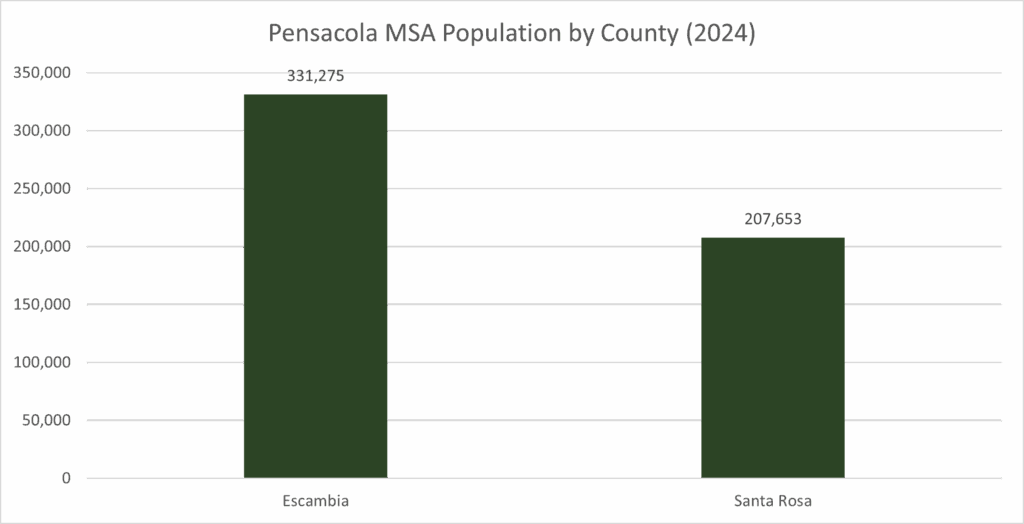
As of the most recent estimates, the Pensacola MSA supports a population of 538,928 with continued growth since the 2020 census, reflecting ongoing in-migration and robust regional appeal.

The economy is anchored by a diversified mix of sectors, including health care & social assistance, retail trade, accommodation & food services, and public administration/military, supported by a workforce of over 225,000. Pensacola’s economic base is further strengthened by a significant military presence, regional health systems, higher education institutions, and a growing professional services sector that has recently placed Pensacola among the fastest-growing U.S. metros for job growth and talent attraction.

Quality-of-life attributes such as beaches, cultural amenities, and natural recreational assets, combined with favorable cost-of-living and strategic transportation infrastructure (including proximity to Interstate-10 and Pensacola International Airport), contribute to the MSA’s appeal among residents, employers, and investors alike.



Pensacola Economy

The Pensacola-Ferry Pass-Brent MSA’s economy has exhibited moderate employment growth, a diverse sector base, and historically low unemployment compared to broader U.S. trends, although labor market indicators have shown some softening in 2025.

Employment and Labor Force

  • The Pensacola MSA labor force comprises roughly 225,000 workers, growing about 2.3% year-over-year, indicating continued job creation and workforce expansion. Health care & social assistance, retail trade, and accommodation & food services are the largest employment sectors by resident workforce.

  • Total nonfarm employment for the MSA has remained relatively stable around 201,000+ jobs as of late 2025.

Sector Composition and Growth

  • Health care & social assistance remains the largest employment sector, followed by retail trade and accommodation & food services, underscoring the region’s combination of essential services, tourism, and regional service demand.

  • Occupational employment data confirms strong concentrations in office & administrative support, food preparation & serving, and sales roles, consistent with service-oriented regional demand.

Population Analysis


The Pensacola MSA has continued its long-term growth trajectory through the early 2020s. Following the 2020 U.S. Census count of 511,503 residents, the regional population increased to 538,928 in 2024, marking solid expansion driven by natural growth and in-migration. This represents a 5.69% increase.

Demographics

Total Population (MSA)
538,928
Population Growth (2020-24)
5.69%
Unemployment Rate (November 2025)
5.5%

Multifamily Highlights

Pensacola Multifamily Analysis


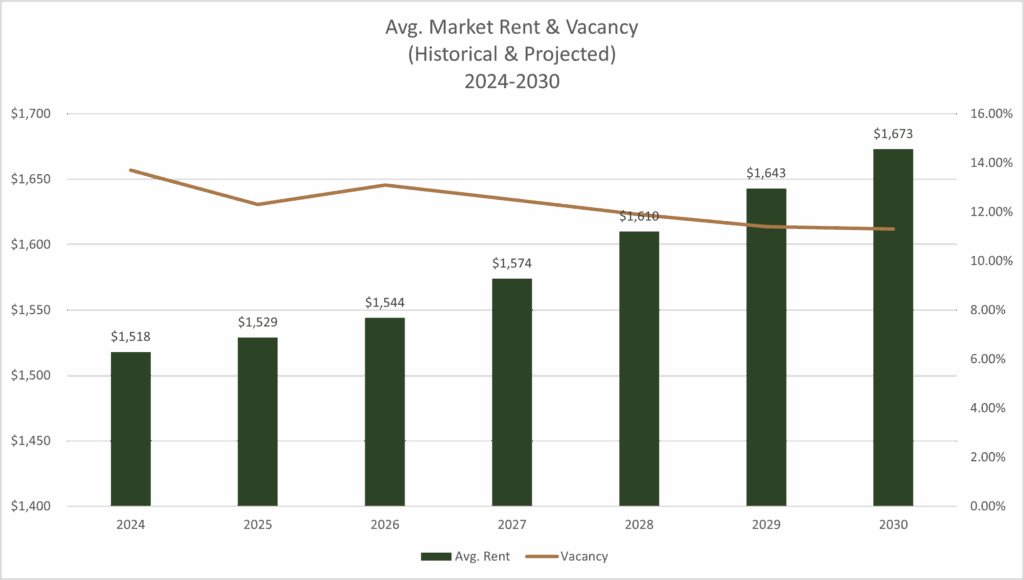
Pensacola’s multifamily market is transitioning out of a multi-year supply-driven imbalance and into a period of gradual stabilization. After several years in which new deliveries consistently outpaced renter demand, fundamentals are beginning to recalibrate as development activity slows and absorption improves. Average Asking Rent in the Pensacola MSA is $1,529, while 12-Month Rent Growth was 0.6%.

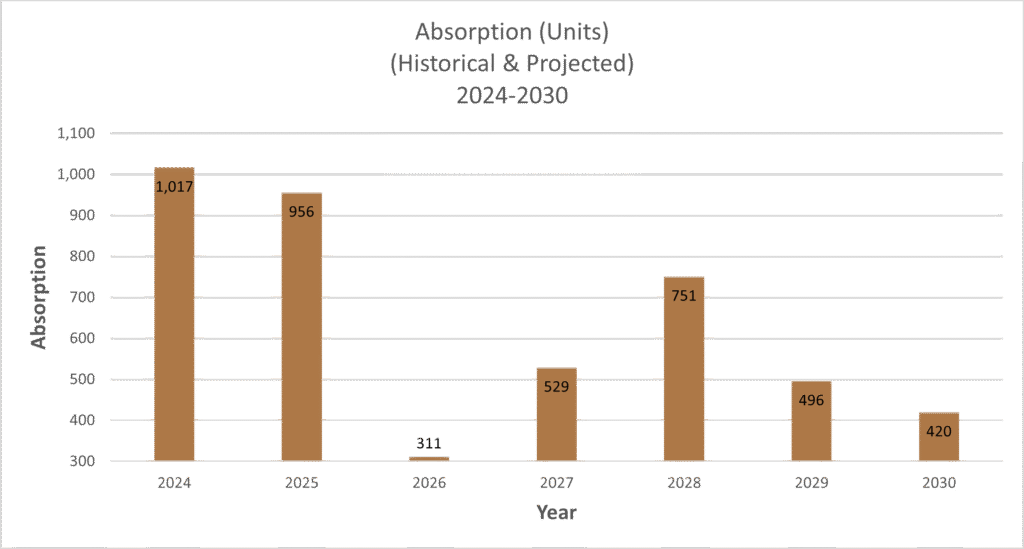
As of Q1 2026, the market comprises 34,181 apartment units, following the delivery of more than 6,000 units over the past five years, representing nearly 30% inventory growth. While this surge placed sustained pressure on occupancy and rent growth, the dynamic shifted in 2025, when absorption exceeded new supply for the first time since 2020. Trailing 12-month absorption totaled 907 units, outpacing 667 units delivered, signaling a meaningful inflection point in demand fundamentals.

Market vacancy has begun to trend downward, declining 150 basis points year-over-year to 12.3%. This recent improvement reflects stronger leasing velocity and a sharp slowdown in new construction. Vacancy performance varies by asset class, with 4 & 5 Star properties capturing the majority of recent absorption, while mid-tier 3 Star assets have demonstrated relative stability.

Looking ahead, forecasts call for vacancy to continue easing through 2026, with stabilization expected in the low-11% range as existing supply is absorbed and limited new projects deliver.

Development activity is decisively cooling. While more than 1,000 units were delivered over the past year, the active pipeline has contracted significantly. As of Q1 2026, approximately 1,285 units (5.7% of inventory) remain under construction, with few new starts anticipated in the near term due to rising construction costs, elevated insurance expenses, and tighter development economics.

Primary Source: CoStar

Major Employers

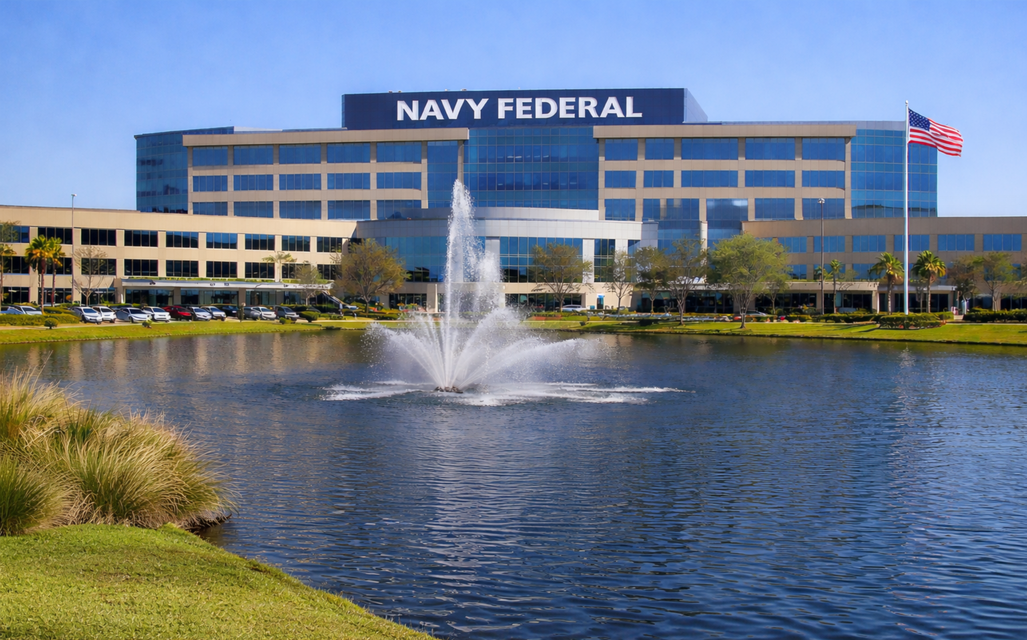
  1. Navy Federal Credit Union Greater Pensacola Operations

    9,188 jobs  | Learn More
  2. Baptist Health Care

    5,434 jobs / 354 beds  | Learn More
  3. Sacred Heart Hospital & Health System

    4,820 jobs / 566 beds  | Learn More
  4. University of West Florida

    2,447 jobs / 14,797 enrollment  | Learn More
  5. Pensacola Christian College

    1,584 jobs / 4,500 enrollment  | Learn More
  6. Ascent Performance Materials

    1,288 jobs  | Learn More
  7. HCA Florida West Hospital

    1,200 jobs / 515 beds  | Learn More
  8. LifeView Group

    1,199 jobs  | Learn More
  9. Innisfree Hotels

    750 jobs  | Learn More
  10. GE Vernova

    700 jobs  | Learn More
  11. Pensacola State College

    600 jobs / 8,518 enrollment  | Learn More

Other Demand Drivers

  1. Cordova Mall

    929,685 SF; Best Buy, Dick's, Belk, Dillard's  | Learn More
  2. Pensacola International Airport

    AA, Delta, Frontier, Southwest, Spirit, United, Breeze, Contour  | Learn More
  3. Community Maritime Park

    Capacity of 5,038; Home of AA Pensacola Blue Wahoos  | Learn More
  4. Pensacola Beach

    #1 Best Beaches in the United States (2025, Conde Nast)  | Learn More

Sources & Comments

1. The Pensacola-Ferry Pass-Brent, FL Metropolitan Statistical Area consists of 2 counties (1) Escambia (2) Santa Rosa

2. Primary Sources: (1) https://fred.stlouisfed.org/ (2) YardiMatrix (3) RentCafe.com (4) CoStar (5) rcanalytics.com (6) www.bls.gov (7) https://www.floridawesteda.com

3. Sales Comps are from 2025

4. Development Pipeline as of 1/16/2026

5. This information supplied herein is from sources we deem reliable. It is provided without any representation, warranty, or guarantee, expressed or implied as to its accuracy